10 Best Webflow Agencies in India for 2026
.avif)
.png)
.png)

.png)
.png)
.svg)
If you’re reading this, you already know Webflow is the smarter way to build a website. It gives you speed, control, and the freedom to update pages without waiting on a developer every time you want to change a headline. That part is settled.
What isn’t settled is the part that actually matters, which Webflow agencies in India you should trust to build your site, so it becomes an asset, not another project that needs fixing six months later.
Every founder eventually discovers this the hard way. The platform is powerful, but the outcome depends entirely on the team behind it. One agency will leave you with a system your team can scale for years. Another will hand over a pretty website that collapses the moment you try to update something simple.
That gap is exactly why this list exists. Not to tell you what Webflow is. Not to re-explain no-code. But to help you choose Webflow agencies in India that can build a site that moves as fast as your team, supports your growth, and doesn’t break under real-world use.
If you want clarity, not guesswork, you’re in the right place. Let’s get into it.
Why Webflow Has Become the Platform of Choice
Webflow didn’t take off in India because it was “easier.” It took off because teams finally got tired of the old way of building websites: delayed launches, plugin chaos, last-minute bugs, and agencies treating every small change like a mini project. Indian founders hit a breaking point, and Webflow arrived right when the country’s digital expectations shifted.
Three things pushed the shift to Webflow agencies in India:
1. India’s startup culture now moves at “demo-day speed”
The pace here is different. A founder raises a seed round and wants a new website ready before investor announcements go live. A product team ships a feature and expects a landing page the same week. Marketing teams launch campaigns in hours, not quarters.
Webflow agencies in India matched that rhythm by letting teams edit, ship, and test without hoping a developer was free that day. In India, speed isn’t a vanity metric. It’s survival.
2. Indian brands jumped straight from “agency-dependent” to “design-first”
Most Western companies eased into Webflow after years of CMS fatigue. India skipped that phase entirely.
We went directly from: “We need a developer for everything” → “Why can’t our website behave like our product?”
That shift made Webflow an instant fit because it brings design, logic, and CMS together in one place.
No plugin hunting.
No version conflicts.
No surprise crashes the night before a campaign.
For fast-scaling Indian teams, that level of clarity is gold.
3. Global design standards hit India hard
Indian users now scroll through Reels, browse Notion, and experience Apple-level UI daily. The definition of “good design” jumped overnight.
Suddenly:
- Cluttered layouts felt outdated
- Slow sites felt untrustworthy
- Template-style pages weren’t acceptable
- Founders wanted taste, not themes
Webflow gave Indian designers the same playground global teams were using, and Webflow agencies in India who understood modern UX turned that freedom into actual business outcomes.
Even global giants use Webflow today like Dell, Zendesk, Rakuten, Dropbox Sign, all highlighted by Webflow’s customer stories. India’s following the same path. And Webflow agencies in India that deeply understand the tool are becoming key partners for modern brands.
How a Webflow Agency Strengthens Your Business
Hiring Webflow agencies in India isn’t just about getting a nice-looking site. It’s about upgrading the way your business runs online. The right agency can speed up your launches, tighten your messaging, lift your conversions, and give your team the freedom to move without friction.
Here’s the real role Webflow agencies in India play in your business success:
1. They help you move faster without chaos
A good Webflow agency in India doesn’t just design pages. They remove bottlenecks. Launching a campaign shouldn’t take two weeks of back-and-forth. The right team speeds up how you ship pages, test ideas, and roll out updates so your marketing doesn’t depend on long dev cycles.
Quick Tip: Ask the agency how quickly they can launch a new landing page once the design is approved. Their answer will tell you everything.
2. They protect your brand as you grow
Websites often break when different people start touching them. Good Webflow agencies in India create a layout system where everything behaves predictably. Every page feels like part of the same brand, even six months later when three different team members have made updates.
Micro example: Think of it like a Figma library inside Webflow. Clean, predictable, reusable.
3. They improve UX that leads to conversion
UX isn't decoration. It's how clearly users understand what you do, where to click, and why it matters. Webflow agencies in India that know Webflow well can design pages that reduce friction, guide decisions, and help users reach the next step without confusion.
Try this: Ask the agency which section on your homepage drives the highest drop-off. Their response shows whether they think like strategists or decorators.
4. They set up SEO + performance the right way
Visibility comes from structure. Clean URLs, logical hierarchy, compressed assets, schema, and fast load times. Good Webflow agencies in India set these foundations early so your redesign doesn’t hurt your rankings or worse, break them.
Pixeto’s expertise: We’ve seen sites gain faster indexation just because the sitemap and structure were rebuilt properly.
5. They build a CMS your team can use with confidence
Webflow’s CMS is powerful, but only if it's planned well. Mature Webflow agencies in India build in a way your team can manage updates without worrying about breaking layouts. This reduces dependency, saves developer hours, and speeds up content marketing.
Micro actionable: Before signing, ask the agency to show you a CMS they built for another client. Not the site, the dashboard.
6. They future proof the website
Most websites age poorly because they weren’t built for growth. Good Webflow agencies in India build naming systems, components, and structures that scale. That means you won’t need a rebuild every time your business evolves.
Food for thought: Good agencies think like system designers, not page builders.
How to Choose the Right Webflow agencies in India for Your Project
By this stage, you’re not comparing colour palettes or scrolling through pretty portfolios of Webflow agencies in India. You’re choosing a partner who will shape the backbone of your digital presence for the next few years, a system your marketing, product, and leadership teams will rely on every single week.
After reviewing several Webflow builds across Indian startups, SaaS brands, and growth-stage companies (including the broken ones named “Div Block 27 Copy Copy”), we realised something important:
Every successful Webflow project is the result of four forces. The same ones behind effective product teams.
We took inspiration from the classic 4P Marketing Mix and reshaped it into a practical, founder-friendly way to evaluate Webflow agencies in India.
Here it is.
Pixeto’s 4-P Webflow Evaluation Framework
The simplest way to separate real Webflow agencies in India from pretty-but-fragile vendors.
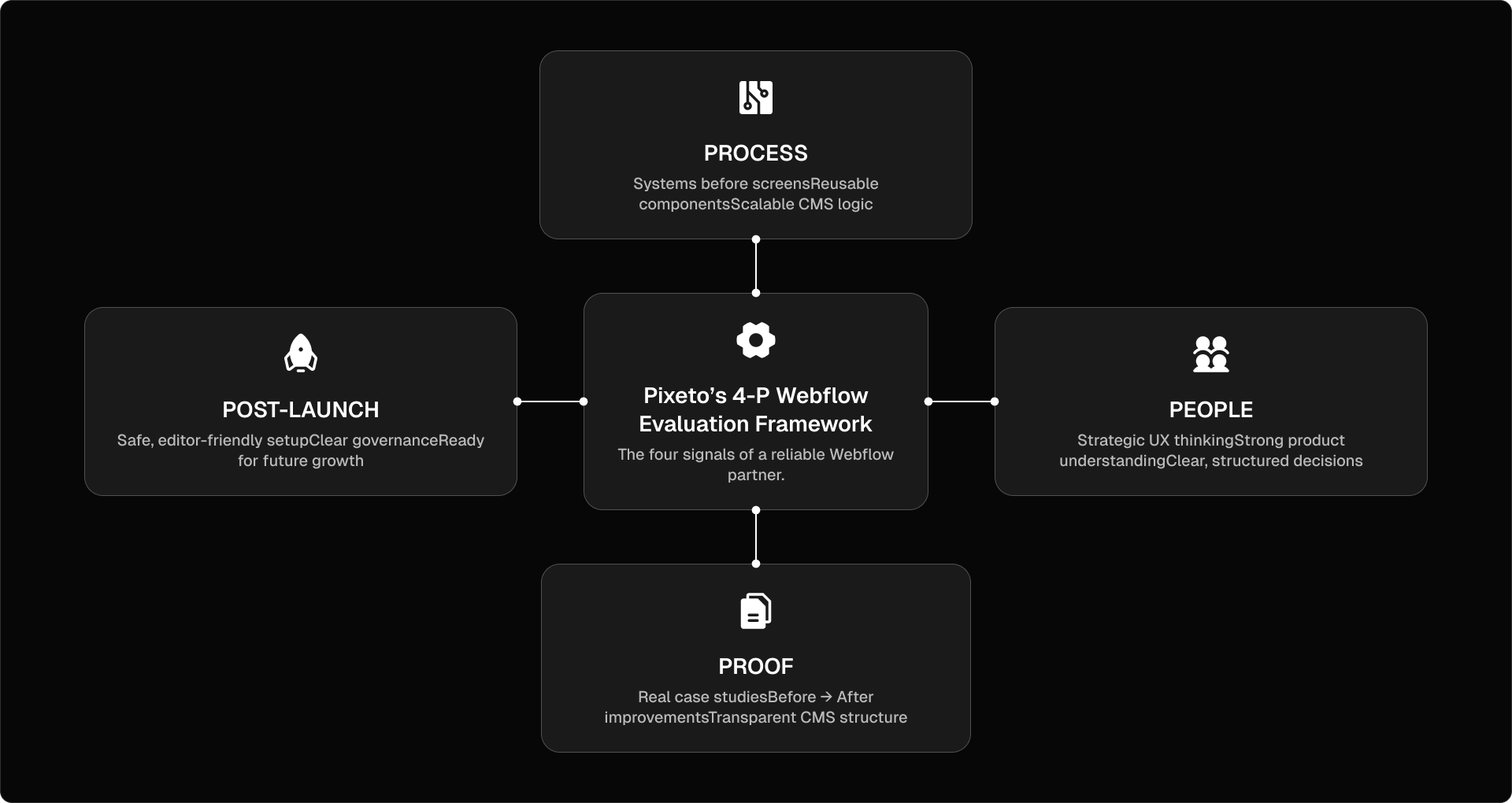
1. Process - How They Build When No One Is Watching
We evaluate “Process” because most Webflow failures have nothing to do with design quality.
They happen when the foundation is improvised: sloppy CMS logic, duplicated classes, broken components, and endless revisions that show up only when the site is finally in your hands. The better Webflow agencies in India work with the discipline of a product team.
What that looks like:
- Transparent sprint structure
- Component planning before any visual design
- Real wireframes (not decorative placeholders)
- Documentation your non-design stakeholders can understand
- Governance for CMS, global styles, and interactions
A solid process absorbs scope changes without derailing the project. It prevents the “we’ll fix it later” debt trap and keeps your build scalable long after launch.
Quick test: Ask to see their workflow, not their wallpapers. If they can show you naming conventions, CMS modelling, and how components evolve through sprints, you’ve found a real partner.
2. People - The Actual Engine Behind Your Website
We evaluate “People” because tools don’t build great websites, judgment does. And judgment comes from the humans in the room, not the platform they use.
A capable Webflow agency in India is defined by the people who can translate your product into clarity. Designers who understand UX logic, strategists who understand markets, and developers who understand Webflow’s constraints, all working in sync. You can usually identify this within minutes.
What strong talent looks like:
- They understand your product quickly
- They ask questions that tighten your positioning
- They translate ideas into structured screens
- They spot content gaps before you do
Your website is only as strong as the people making decisions behind it. If the team doesn’t understand your business, your architecture, or your narrative, the site will always need “fixing later.”
Quick test: Explain your product in 60 seconds. If the team stays silent, you’re buying rework. If they start drawing mental models immediately, you’re in good hands.
3. Proof - Evidence That They Deliver Results
We include “Proof” because every Webflow agency has glossy screenshots. Very few can show the invisible parts that matter like how they structured a CMS, improved speed, migrated from WordPress, or turned a messy system into a scalable one.
What meaningful proof looks like:
- Case studies that explain decisions, not decorations
- Before → after improvements (speed, conversions, clarity)
- Screenshots of CMS modelling or design systems
- Clients praising process, not just aesthetics
- Migration examples (a real test of technical skill)
Proof reduces uncertainty. It tells you whether the agency delivers consistency, or just lucked into one good project.
Quick test: Ask for one case study where something went wrong and how they solved it. Real teams always have real stories. Pretenders don’t.
4. Post-Launch - The Part Everyone Forgets Until It’s Too Late
We added “Post-Launch” because the real test of a Webflow build begins the moment your team starts using it.
Most agencies vanish after handover. The best Webflow agencies in India make sure your site stays stable when you add new pages, expand your product, or scale campaigns. This is where governance, documentation, and editing logic matter far more than animations.
What a good post-launch structure includes:
- Clear documentation for CMS, naming, and components
- Guardrails that prevent brand drift
- Editor access that feels safe, not scary
- A plan for adding future pages
- Support options that actually match your pace
A beautiful website is useless if your team is scared to touch it. Post-launch is where your investment either compounds or collapses.
Quick test: Ask the agency to show how a non-designer on your team will update a headline, add a CMS item, or create a new page. If it looks intuitive, the build is right. If it looks risky, your maintenance bill is coming.
When you look at Webflow agencies in India through these four lenses, the differences become obvious, not in the visuals, but in the thinking.
Now, let’s look at the Webflow agencies in India that actually meet this standard.
10 Best Webflow Agencies in India for 2026
India’s Webflow ecosystem is still young, but the quality has become easier to spot.
Some agencies use Webflow as a visual tool.
The better ones use it as a system, with clear naming, scalable CMS structures, reusable components, and design that holds its shape as the brand grows.
This list is a simple, founder-friendly reference of Webflow agencies in India whose publicly available work consistently shows solid Webflow fundamentals. No rankings, no hype. Just an honest view of what each team is known for.
1. Pixeto
Pixeto is a strategic brand and web partner to B2B tech companies between seed and scale. Strategy comes before design in every engagement: what the site needs to say, to whom, and why, gets settled before anything is built in Webflow.
The work shows up at defining moments. WhizAI’s rebrand and Webflow rebuild went live alongside their $8M Series A, and Pixeto stayed their design partner for four years. Invary’s redesign shipped the day their $3.5M seed round was announced. Opal raised its pre-seed on the brand and site Pixeto built, and is still a client today.
Engagements are founder-led and fixed price, with a CMS the client’s own team can run without developers. Most projects go from kickoff to launch in 6 to 12 weeks.
If your product has outgrown your website, this is where Pixeto does its best work.
2. Flowchef
Open a FlowChef project and you’ll instantly notice how alive the experience feels. Their interaction work has polish, not the heavy, slow animation style you sometimes see, but light, intentional motion that guides your attention.
They bring personality without sacrificing speed. Their designs feel modern, energetic, and fun in a way that enhances the brand rather than overpowering it.
If you want a site that has visual flair and purposeful micro-interactions, FlowChef brings that creative spark.
3. ActiveSet
ActiveSet has a way of taking dense, B2B-heavy content and making it feel genuinely readable.
When you look at their work, the flow feels clean, the copy has breathing room, and the pages make sense even when the content is complex.
No clutter. No unnecessary visuals. Just structured, decision-friendly UX that respects how B2B buyers actually navigate websites.
If you’re a SaaS or consulting brand drowning in information, ActiveSet helps your site feel organised and credible.
4. EverythingFlow
EverythingFlow is all about clean builds, smart structure, and CMS setups that behave exactly the way they should. Their work shows clear naming systems, sensible layouts, and no unnecessary complexity, which is rare and refreshing.
They’re the kind of team that ships what they promise, keeps the build easy to maintain, and avoids Webflow gimmicks.
Perfect for founders who want solid execution without multiple rounds of back-and-forth.
5. Mostli
Mostli has a sharp eye for modern UI. Their layouts feel crisp, well-spaced, and globally relevant, the kind of design that immediately elevates an early-stage startup’s credibility.
Nothing too loud, nothing too experimental, just clean, current, contemporary design that looks great and loads fast.
If your brand wants a simple, modern, tech-forward look, Mostli is a very safe choice.
6. NitrousDesign
Nitrous’ work feels like it was designed by someone who thinks in user flows. Pages read logically, spacing feels intentional, and you can see the connection between UX decisions and Webflow execution.
Their builds are clean, product-friendly, and approachable, especially useful if your team values structure as much as aesthetics.
Great for SaaS and product-first brands who want clarity and UX-led design.
7. EPYC
EPYC brings a premium, polished aesthetic that sits comfortably in the global SaaS design space. Their work often features refined visuals, strong typography, and clean layouts that feel carefully art-directed.
It’s the kind of design that makes a brand look funded, confident, and mature, without being overproduced.
If “premium SaaS look” is the goal, EPYC delivers it well.
8. FlowDojo
FlowDojo is one of those studios that quietly nails the fundamentals. Their builds are clean, fast, stable, and consistent, the kind of work you appreciate months later when everything still loads smoothly and edits don’t break layouts.
They’re Webflow-focused, efficient, and dependable, making them ideal for projects that need quality and speed without complications.
9. BaseNine
BaseNine’s work is peaceful in the best way. Minimal, thoughtful, spacious, the kind of design that lets content breathe and brands feel more premium.
Their typography choices and layout decisions give off a calm, confident vibe that stands out in a sea of overly busy websites.
Perfect for brands that want simplicity, elegance, and modern minimalism.
10. Brandemic
Brandemic brings branding and Webflow together, which gives their projects a cohesive, aligned feel.
The identity, colour, typography, and layout all speak the same language — something that’s surprisingly rare in India’s Webflow scene.
If you want a website that reflects your brand story end-to-end, Brandemic is a solid option.
Side-by-Side Comparison of Top Webflow Agencies in India
Each team on this list is strong, but they shine in different areas like design, structure, motion, speed, or long-term scalability.
This table gives you a quick, no-nonsense view of what each agency does best so you can shortlist faster and speak to the right Webflow agencies in India.
| Agency | What They’re Known For | Design Style | Build Strength | Best For | Delivery Pace |
|---|---|---|---|---|---|
| Pixeto | System-first, scalable Webflow architecture | Clean, modern, structured | CMS logic, UI hierarchy | SaaS, B2B, product teams needing clarity | Structured, steady |
| FlowChef | Purposeful interactions + lively visuals | Playful, motion-led, energetic | Micro-animations, UX motion | Startups, creative brands | Fast–medium |
| ActiveSet | B2B clarity + information-heavy UX | Minimal, content-forward | Structure, readability | B2B, consulting, enterprise pages | Predictable, methodical |
| EverythingFlow | Clean, disciplined Webflow dev | Simple, practical | Naming, CMS stability | Product teams, founders who want “no drama” | Fast, efficient |
| Mostli | Contemporary UI for tech brands | Crisp, modern, global SaaS vibe | UI polish, layout clarity | Startups, early-stage brands | Fast |
| NitrousDesign | UX-first, product-friendly layouts | Clean, structured | Flow, hierarchy | SaaS/products needing UX clarity | Medium–fast |
| EPYC | Premium visuals + polished SaaS aesthetic | Refined, premium, sharp | Visual direction | SaaS, funded teams, premium brands | Medium |
| FlowDojo | Webflow-only, stable scalable builds | Simple, neat | CMS consistency, performance | Teams needing speed + reliability | Fast |
| BaseNine | Minimal, calm, typography-led interfaces | Minimal, spacious | Simplicity, clarity | Premium/D2C/modern minimal brands | Fast |
| Brandemic | Brand + Webflow under one roof | Cohesive, identity-led | Brand consistency | Brands needing identity + website alignment | Medium |
What to Avoid When Working with Webflow agencies in India
Most Webflow failures don’t happen at launch. They happen quietly, in discovery, in architecture, in how decisions are made, and in how your team updates the site later.
To help you avoid expensive rebuilds, we built a four-stage filter that instantly reveals whether an agency will scale with you or slow you down.
Each stage gives you:
- The real risk (why this stage sinks projects)
- A practical checklist (what to verify)
- A Quick Fix (what to ask immediately)
1. Discovery Depth - When the Agency Doesn’t “Get” Your Business
If the agency misinterprets your product, everything downstream becomes compromised like the messaging, the structure, the calls-to-action, the visual hierarchy. Most rebuilds happen because the first 2 weeks were shallow, not because the designs were weak.
Checklist - Ask yourself:
- [ ] Did they reorganise your pitch into something clearer?
- [ ] Have they spotted gaps in your narrative before you mentioned them?
- [ ] Are they asking for funnel or behavioural data, not just “brand guidelines”?
- [ ] Can they summarise your product in one sentence without mixing features and outcomes?
- [ ] Did they challenge vague claims instead of designing around them?
Quick Fix to Ask: “What would you remove from our current homepage and why?” Strong agencies remove noise with confidence. Weak ones redesign the noise.
2. Architecture & Scalability - When the Site Breaks the Moment You Update It
A Webflow site doesn’t break because of design, it breaks because of architecture. If CMS logic, naming conventions, and components aren’t planned upfront, the moment your team publishes a blog, spacing breaks, layouts shift, and the whole site becomes fragile.
Checklist - Verify whether they:
- [ ] Present a CMS model before showing UI
- [ ] Explain structure using plain English
- [ ] Build components before pages
- [ ] Demonstrate how future pages inherit styles
- [ ] Protect global styles from accidental edits
Quick Fix to Ask: “Show me how you’d structure our CMS for blogs, case studies and product pages, right now, on a whiteboard.” Real experts sketch instantly. Pretenders “need more time.”
3. Process & Predictability - When Every Review Feels Like a Guess
The best builds feel calm. Weak agencies feel like a moving target, shifting timelines, inconsistent updates, ambiguous feedback cycles. Predictability is what prevents spirals, rework and scope creep.
Checklist - Check if they:
- [ ] Share a milestone-level project plan (not vague timelines)
- [ ] Use functional wireframes, not pretty placeholders
- [ ] Run structured reviews with clear acceptance criteria
- [ ] Document decisions throughout, not at the end
- [ ] Separate UX, content, components and UI into stages
Quick Fix to Ask: “Show me a Figma → Webflow workflow from a past project.” If they can’t demonstrate a repeatable system, the “process” is luck.
4. Post-Launch Ownership - When You’re Trapped Needing the Agency Forever
Most sites look great at launch… until your team updates something. Without documentation, guardrails and logical CMS design, your website becomes a dependency instead of an asset.
You lose speed. Costs rise. Momentum drops.
Checklist - Look for:
- [ ] Clear component + CMS documentation
- [ ] Editor permissions that prevent accidental damage
- [ ] A defined process for creating new pages
- [ ] Rules for spacing, grids and layout tokens
- [ ] Transparent post-launch support options
Quick Fix to Ask: “Can you guide my non-designer through updating a page while I watch?” If the process feels intuitive, the build is solid. If it feels risky, your future maintenance cost just doubled.
The Scorecard
If you want a quick, objective way to compare agencies, use this scorecard. Give each category a rating between 1 (weak) and 5 (excellent) based on how confidently the agency meets the checklist.
| Category | Score (1–5) |
|---|---|
| Discovery Depth | ☐ ☐ ☐ ☐ ☐ |
| Architecture & Scalability | ☐ ☐ ☐ ☐ ☐ |
| Process & Predictability | ☐ ☐ ☐ ☐ ☐ |
| Post-Launch Ownership | ☐ ☐ ☐ ☐ ☐ |
Total Score (out of 20): _______
How to interpret your score
- 17-20 → Strong partner - They think long-term, not just launch. High scalability, low risk.
- 13-16 → Good but with blind spots - They can deliver well, but you’ll need to stay involved in decision-making.
- <12 → Likely to slow you down as you scale - Not a deal-breaker, but expect extra oversight, extra fixes, and extra cost.
This isn’t about disqualifying agencies. It’s about making sure you pick Webflow agencies in India who matches your pace, ambition, and internal capability.
Choose Webflow Agencies in India That Build with You, Not Just for You
The difference between a good Webflow build and a great one shows up months after launch. Great teams plan for growth. The rest leave you with surprises.
If you want a team that works with your speed, builds with intention, and leaves no hidden chaos behind the scenes, Pixeto’s your place.
Tell us what you’re building, and we’ll show you the smartest way to do it on Webflow.
FAQs
What is a Webflow agency?
Ans: A Webflow agency is a specialised team that designs, builds, and scales websites on Webflow. Unlike general design studios or no-code freelancers, these agencies understand Webflow’s technical architecture like CMS logic, component systems, performance setups, SEO structure, interactions, migrations, and post-launch governance. Their role isn’t just to “make pages,” but to build a website your team can grow without breaking anything.
Why should I hire a Webflow agency instead of a freelancer?
Ans: Freelancers work best for small, one-off landing pages. Agencies work best when your website has multiple stakeholders, multiple page types, or long-term growth plans. A Webflow agency gives you strategy, UX, design, CMS planning, QA, documentation, and predictable delivery, all under one system. You pay more, but you get structure, scalability, and a site that won’t collapse the moment your team updates it.
How much does it cost to hire a Webflow agency in India?
Ans: Pricing depends entirely on the scope like how many pages you need, the depth of the CMS, the level of design, and whether there are migrations or integrations involved.
Most agencies follow a tiered structure:
- simpler sites at the lower end,
- product or SaaS websites in the middle,
- and complex, custom builds at the higher end.
If you receive a quote that seems unusually low, it’s worth checking what’s not included, rushed architecture and weak process often cost more to fix later.
How long does it take to build a website with Webflow?
Ans: On average, based on typical Webflow agency projects, it takes:
- 4–6 weeks for smaller sites
- 6–10 weeks for SaaS, product, or multi-page marketing sites
- 10–16 weeks for enterprise builds, migrations, or heavy CMS architecture
Speed depends less on Webflow and more on the agency’s process, your content readiness, and how quickly decisions are made.
Can Webflow agencies in India handle SEO and content too?
Ans: Most good agencies do. They handle:
- Technical SEO (structure, schema, indexing, metadata)
- On-page SEO fundamentals
- Content design for pages
- CMS planning for blogs and case studies
Some agencies also offer full content strategy and copywriting, but this varies. Always check whether SEO is built in or offered as an add-on.
Do Webflow agencies offer ongoing support and maintenance?
Ans: Yes, but the level of support differs across agencies. Most offer:
- Monthly or quarterly maintenance
- Minor updates
- New landing pages
- CMS support
- Performance reviews
A few also provide retainers where they work as an extended part of your team. The key is to clarify support terms early like hours, scope, turnaround time, and pricing, so you stay independent, not dependent.