10 Best Webflow Partners: Hire Certified Webflow Experts

.avif)
.png)
.png)

.png)
.png)
.svg)
Looking for trusted Webflow partners or trying to understand the Webflow Partner Program? Choosing the right Webflow professional partner can make all the difference in building a website that’s fast, flexible, and scalable.
In this guide, we’ve handpicked the top Webflow partners to help you achieve your goals, whether you need design, development, or ongoing support. Discover who they are, what makes them stand out, and how to pick the perfect partner for your brand.
What Are Webflow Partners?
Webflow partners are specialists approved through the Webflow Partner Program. They’re designers and developers who’ve shown with Webflow they can build clean, scalable, and well-structured sites.
Think of them as the people who know how to get the best out of the platform, not just make a layout look good.
Source: https://webflow.com/certified-partners/apply
The main difference between a Webflow partner and a regular agency or freelancer is verification. Regular agencies may have talented Webflow experts, but they haven’t been reviewed or recognised by Webflow.
Many agencies who don’t apply work across multiple tools and may not prioritise platform-specific recognition.
Partners, on the other hand, submit their work, share their approach, and demonstrate they can follow Webflow’s recommended standards. Many choose to do this because it adds credibility, helps them attract better-fit clients, and shows they specialise in the platform.
Once Webflow approves a partner, they’re listed officially. The “partner” badge simply means Webflow has seen their work and trusts their expertise.
A certified partner understands how Webflow really works. They know how to set up a CMS that stays organised, build components you can reuse, keep performance healthy, and create smooth interactions with Webflow’s animation tools.
Their work is reviewed against Webflow’s criteria for structure, performance, accessibility, and design quality, so you get a site that feels stable and easy to manage long after launch.
Pro Tip: When you review a Webflow partner’s profile, look at how they structure CMS collections in their showcases. That tells you more than the homepage visuals.
Most teams choose Webflow partners because they’ve already seen what these experts have delivered for other startups, SaaS companies, and enterprise brands. They’re used to working with marketing teams, product teams, and founders who need clarity instead of complexity. And they offer support beyond launch, which helps your site stay consistent as it grows.
In simple terms, working with a certified Webflow partner means you’re getting a team that knows what works, builds it right, and keeps your website ready for whatever comes next.
10 Best Webflow Partners to Hire in 2026
Choosing a Webflow partner shouldn’t feel like flipping through a directory. Each team in this list has a distinct way of thinking, building, and solving problems and that’s what actually matters when you’re deciding who should own your website architecture for the next few years.
Below is a breakdown of what each partner is truly known for, where they shine, and how to choose based on your goals.
1. Pixeto
Pixeto is a strategic brand and web partner to B2B tech companies between seed and scale. The work shows up at defining moments: WhizAI’s Webflow rebuild went live alongside their $8M Series A, and Invary’s redesign shipped the day their $3.5M seed round was announced. Strategy comes before design in every engagement.
Why They Stand Out
Pixeto blends brand thinking + Webflow architecture. Most partners jump straight into canvas mode. They start with the narrative, what your website should say, not just how it should look.
Then they translate that into components, CMS structures, and a design system your team can easily manage.
Key Services
- Brand-first Webflow websites
- Design systems & component libraries
- CMS architecture + scalable content models
- SaaS sites, B2B sites, and founder-led brands
- Ongoing support + monthly iterations
Strengths
- System thinking
- Clear content hierarchy
- Brand storytelling woven into layout
- Stable CMS setups that don’t collapse six months later
Ideal For
Startups, SaaS companies, and businesses with a strong story who want a site that looks good and stays easy to update as the team scales.
Best Fit When
You need clarity, narrative alignment, and a Webflow system built around your brand, not just your pages.
When to Choose Another Partner
You only need a quick, template-style landing page with minimal strategy or systems thinking.
How They Think
Pixeto asks the questions that reveal the real structure behind your site, like “What will your team update weekly?” That’s where the CMS decision is made.
2. Finsweet
Finsweet is one of Webflow’s most technically capable partners. They’re known globally for their Client-First framework and for solving the types of problems most teams think Webflow “can’t do.”
Why They Stand Out
They combine creativity with engineering logic, rare in the Webflow space. They’re also the team other agencies learn from (Client-First is practically industry standard).
Key Services
- Enterprise-grade Webflow builds
- Complex CMS relationships
- Custom logic, API integrations, automations
- Accessibility & performance optimisation
- Rebrands at scale
Strengths
- Bulletproof development
- Deep Webflow platform knowledge
- Able to push Webflow into “custom-app” territory
- Rock-solid documentation
Ideal For
Large SaaS teams, enterprise content hubs, and companies with heavy CMS needs.
Best Fit When
Your website needs deep CMS logic, automation, custom integrations, or complex user flows inside Webflow.
When to Choose Another Partner
Your focus is purely visual expression or motion-heavy storytelling rather than technical architecture.
How They Think
Systems first. Pages later. They’ll show you how each CMS collection interacts before they design a pixel.
3. Flow Ninja
Flow Ninja builds with scalable marketing teams in mind. They structure sites so content editors can move fast like publishing pages, updating modules, and launching campaigns without developer dependency.
Why They Stand Out
Their builds feel “structured but friendly,” technical enough to scale, simple enough for non-tech teams to use confidently.
Key Services
- Webflow development
- CMS modeling for high-volume content
- Growth-focused SaaS websites
- Animation-light, performance-safe builds
Strengths
- Fast iteration cycles
- Optimised CMS for large marketing teams
- Clean, predictable component systems
Ideal For
SaaS companies, product teams, and high-tempo marketing orgs.
Best Fit When
Your team publishes content frequently and needs a predictable, stable CMS that supports aggressive marketing velocity.
When to Choose Another Partner
Your priority is high-concept motion design or art-direction-heavy visuals.
How They Think
They design for future you, “if your team publishes 50 pages in a month, nothing should break.”
4. SVZ
SVZ produces some of the cleanest, most refined Webflow websites. Their style leans modern, sharp, and highly considered, with a strong focus on brand experience.
Why They Stand Out
Precision. Every layout, interaction, and whitespace decision feels intentional.
Key Services
- High-end brand websites
- Minimalist, refined UI/UX
- Webflow development with a design-first approach
- Motion that feels subtle, not flashy
Strengths
- Visual craft
- Polished experiences
- Beautiful hierarchy and typography
- Premium design quality
Ideal For
Brands that want a website that feels elevated, elegant, and timeless.
Best Fit When
You want premium design, clean visuals, modern UI, and a polished, minimalist aesthetic.
When to Choose Another Partner
Your project requires complex backend logic, multi-layered CMS structures, or system-first scalability.
How They Think
They remove complexity before they add beauty, which is why their sites feel seamless.
5. ActiveSet
ActiveSet focuses on clarity, structure, and business logic. Their websites feel grounded, logical, and easy for B2B teams to expand.
Why They Stand Out
They understand how B2B buyers think and build sites that help teams communicate clearly.
Key Services
- B2B websites
- Content-driven CMS setups
- UX for sales journeys
- Scalable component libraries
Strengths
- Clear content flows
- Scalable information architecture
- Fast-to-update systems
Ideal For
Tech, consulting, and B2B companies who care about clarity over theatrics.
Best Fit When
Your website needs clean UX, logical content hierarchy, and a structure that supports B2B sales journeys.
When to Choose Another Partner
You want expressive motion design or visually experimental brand storytelling.
How They Think
They ask, “If a new team member joins tomorrow, can they update this page without help?”
6. RocketAir
RocketAir is known for brand storytelling, motion design, and immersive experiences. Their sites feel alive with animation used with intention, not for show.
Why They Stand Out
They blend storytelling, motion, and modern brand language better than almost anyone in the Webflow space.
Key Services
- High-end brand websites
- Motion design + animation
- Art direction + storytelling
- Full design-to-Webflow execution
Strengths
- Stunning motion sequences
- Memorable brand experiences
- Deep conceptual design
Ideal For
Product brands, funded startups, and teams who want a “wow” effect.
Best Fit When
You're building a narrative-driven website with motion, expressive visual identity, and a strong storytelling arc.
When to Choose Another Partner
Your project requires large-scale CMS systems or prioritizes technical scalability over creative expression.
How They Think
They treat the homepage like a story arc, emotion first, UI second.
7. Digidop
Digidop is known for speed, efficiency, and clean development, with a strong base of European SaaS and startup clients.
Why They Stand Out
They deliver fast, predictable Webflow builds and avoid unnecessary complexity.
Key Services
- Design + dev
- SEO-conscious builds
- CMS modeling
- Launch pages + campaign websites
Strengths
- Quick turnaround
- Component-driven builds
- Good balance of design and dev
Ideal For
Startups that need something solid, clean, and delivered fast.
Best Fit When
You need quick, clean Webflow execution with minimal complexity and a predictable delivery timeline.
When to Choose Another Partner
Your project calls for advanced custom logic or highly bespoke motion sequences.
How They Think
They strip builds down to what's essential and focus on predictable outcomes.
8. FlowChef
FlowChef’s strength is crisp, modern Webflow builds with strong use of Lottie, animations, and visual storytelling.
Why They Stand Out
They bring flavour (pun intended), motion, modern layout patterns, and a visual creativity that stands out.
Key Services
- Webflow development
- Interaction-heavy sites
- Lottie integrations
- Modern, playful design
Strengths
- Smooth animations
- Creative layouts
- Visual punch
Ideal For
Startups, creative brands, and teams who want personality.
Best Fit When
Your brand thrives on motion, playful interactions, and visually expressive layouts that add energy to the experience.
When to Choose Another Partner
Your project needs large-scale CMS architecture or a multi-role system designed for heavy internal content teams.
How They Think
They use interactions to guide attention, not distract from it.
9. Relume
Relume revolutionised how Webflow teams build. Their library and AI tools are now part of thousands of workflows including other agencies.
Why They Stand Out
They don’t just build websites. They build tools that shape how the entire ecosystem works.
Key Services
- Design systems
- Webflow development
- Relume Library sites
- Figma-to-Webflow workflows
Strengths
- Fast component-driven builds
- Clear structure
- Excellent for teams who want repeatable patterns
Ideal For
Teams who want strong design + a predictable build process.
Best Fit When
You're building a scalable design system or need a component-driven workflow aligned with Figma-to-Webflow clarity.
When to Choose Another Partner
Your project demands high-concept, art-directed visuals that deviate from reusable patterns.
How They Think
They ask, “Which components will your team reuse 100 times this year?” Then they build for that.
10. BRIX Agency
BRIX builds fast, clean, SaaS-ready sites with excellent structure. Their component libraries and templates are industry favourites.
Why They Stand Out
They move fast without compromising structure, ideal for SaaS teams who need a strong marketing engine, not a visual masterpiece.
Key Services
- SaaS websites
- Template-to-custom builds
- Component-based design
- Webflow development
Strengths
- Speed
- Predictable execution
- Strong SaaS UI patterns
Ideal For
SaaS companies launching or relaunching fast.
Best Fit When
You need a fast, structured SaaS website with proven UI patterns that allow rapid landing-page creation.
When to Choose Another Partner
Your focus is on experimental design, expressive visuals, or deep brand storytelling.
How They Think
They prioritise growth-readiness, “Can your team ship 10 landing pages next month?”
A Side-By-Side Comparison of Webflow Partners
If Webflow partners were cars, their portfolios would be the paint and chrome. But what you actually need to compare is the engine, mileage, and service plan.
This table breaks down exactly that. Directional inputs based on public work and typical engagement models, designed to help you compare fit, not act as hard guarantees.
Think of it as a shortcut to finding the right partner without test-driving ten agencies.
| Partner | Areas of Expertise | Industries Served | Team Size | Support Availability | Project Complexity | Turnaround Time |
|---|---|---|---|---|---|---|
| Pixeto | Strong design Scalable dev Solid SEO Light motion |
SaaS B2B Tech Founder-led brands |
Medium | Ongoing retainers + monthly iterations | Complex brand + CMS systems | Structured Iterative pace |
| Finsweet | Advanced dev Complex CMS Integrations Strong SEO |
SaaS Enterprise Content platforms |
Large | Long-term + enterprise-oriented | Very high technical builds | Methodical System-led |
| Flow Ninja | Strong design Top-tier dev Scalable CMS Solid SEO |
SaaS Startups Product teams |
Medium | Ongoing + agile cycles | High-volume CMS systems | Fast and stable |
| SVZ | Premium design Refined UI Clean dev Subtle motion |
Premium brands Creative Product |
Small/Med | Selective / project-based | Design-led builds | Crafted Detail-oriented timelines |
| ActiveSet | Clear UX Stable dev Strong SEO structure |
B2B Tech Consulting |
Small/Med | Retainer-friendly | Mid–high CMS complexity | Predictable Structured |
| RocketAir | High-end design Storytelling Motion |
Product brands Funded startups |
Medium | Project-based | High design / motion builds | Creative Narrative-driven pacing |
| Digidop | Balanced design/dev SEO-focused Simple motion |
Startups SaaS EU-based tech brands |
Medium | Ongoing or project-based | Medium complexity builds | Fast execution |
| FlowChef | Creative design Smooth interactions Lottie |
Startups Creative brands |
Small/Med | Project-based | Interaction-heavy builds | Fast-to-medium |
| Relume | Strong design Excellent dev Scalable components |
SaaS Digital teams Large content orgs |
Medium | Ecosystem tools + broad support | High complexity, system-led builds | Fast Component-driven |
| BRIX Agency | Strong SaaS UI Solid dev Scalable CMS Clean design |
SaaS B2B startups |
Medium | Ongoing or project-based | Mid–high SaaS marketing complexity | Very fast delivery |
Why You Should Hire a Certified Webflow Partner?
Hiring a certified Webflow partner isn’t about finding someone who knows where the buttons are. Most teams already have a designer or developer who can open the canvas and get a layout working.
What you get from certified Webflow professional partners is the kind of thinking that only comes from building dozens of Webflow sites across different industries and complexity levels.
A Webflow partner brings a deeper understanding of how a Webflow site should be structured so it stays stable as it grows. They plan components that won’t break when new pages are added, set up a CMS that makes sense for your editors, and design interactions that feel polished without affecting performance.
These decisions often go unnoticed on launch day but become very noticeable once the website expands.
Try this quick check: Ask partners to show you a component they’ve scaled across 20+ pages. Their answer will tell you how they think.
Certified Webflow partners also think through the system behind the visuals. They map how content will flow, what your team will update often, and how to keep things organised so future edits don’t feel overwhelming. This is the kind of planning that keeps your website feeling manageable months later, not just on the day it goes live.
Another advantage is perspective. Webflow partners have seen patterns across SaaS brands, ecommerce teams, agencies, and fast-moving startups. They understand what slows teams down and what helps conversion, because they’ve solved similar challenges for others.
Caveman moment: The caveman thinks animations break sites. A partner knows when interactions help conversion and when they are noise.
And then there’s support. Certified partners usually stay involved after launch, helping you refine the site as your brand evolves. They don’t disappear once the project is delivered. You get people who already understand your build and can keep it running smoothly without rebuilding anything from scratch.
So, if you’re exploring Webflow partners, the value isn’t just in the build. It’s in the experience, foresight, and long-term clarity they bring to your website.
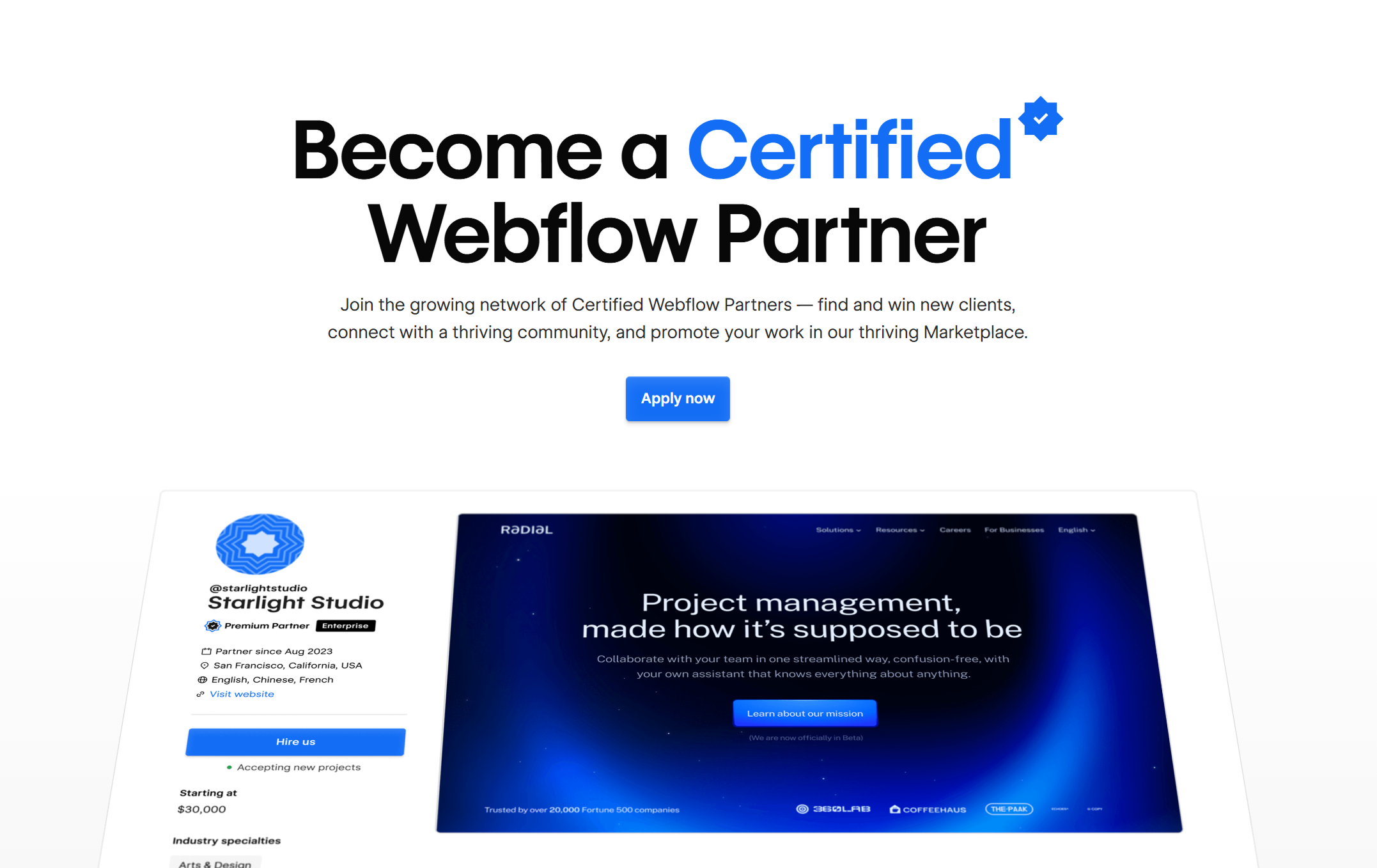
Source: https://webflow.com/certified-partners/apply
How to Choose the Right Webflow Partner
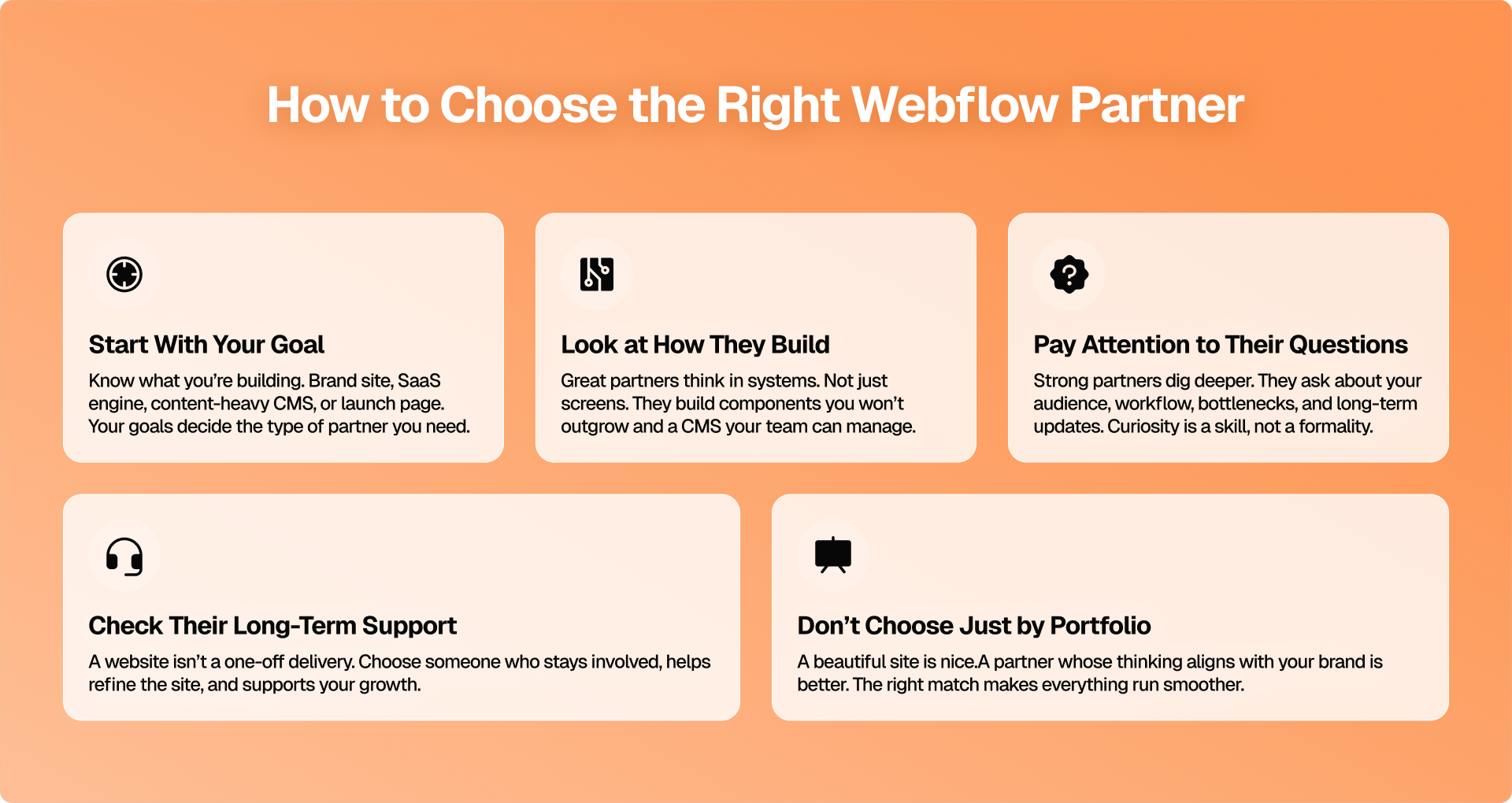
To choose the right Webflow partner, begin by getting clear about what you want your next website to do. A brand site, a SaaS marketing engine, a content heavy CMS, or a product launch page each demands a different approach. Once your goals are defined, it becomes easier to spot the partners who naturally align with your vision.
Figma-style clarity trick:
Create a simple 3-column doc:
- Must-haves
- Nice-to-haves
- Not neededShare this before the kickoff. It saves days!
After that, look at how they build. Great Webflow partners think in systems, not screens. They know how to structure components, plan a CMS you won’t outgrow, and design interactions that feel smooth without slowing down the site. This is the kind of thinking that keeps your website flexible and stable months after launch.
When you speak with potential partners, pay attention to the questions they ask you. Good ones don’t jump straight to colours and layouts. They want to understand your audience, your content workflow, your internal bottlenecks, and how your team plans to update the site. Their curiosity is often the clearest sign of how well they’ll guide your project.
Ask this in your first call: “How will my team update content without touching the layout?” A real partner answers confidently.
And finally, look at how they support clients beyond launch. A website isn’t a one-time delivery. Your Webflow partner should be someone who can help you evolve the site as your brand, product, and goals shift over time. The right partner makes future updates easier, not harder.
Choosing a Webflow partner isn’t about picking the flashiest portfolio. It’s about finding a team whose thinking matches the direction you want your brand to grow. When you find that alignment, the entire project moves smoother, faster, and with far fewer surprises.
How to Get Started with A Webflow Partner
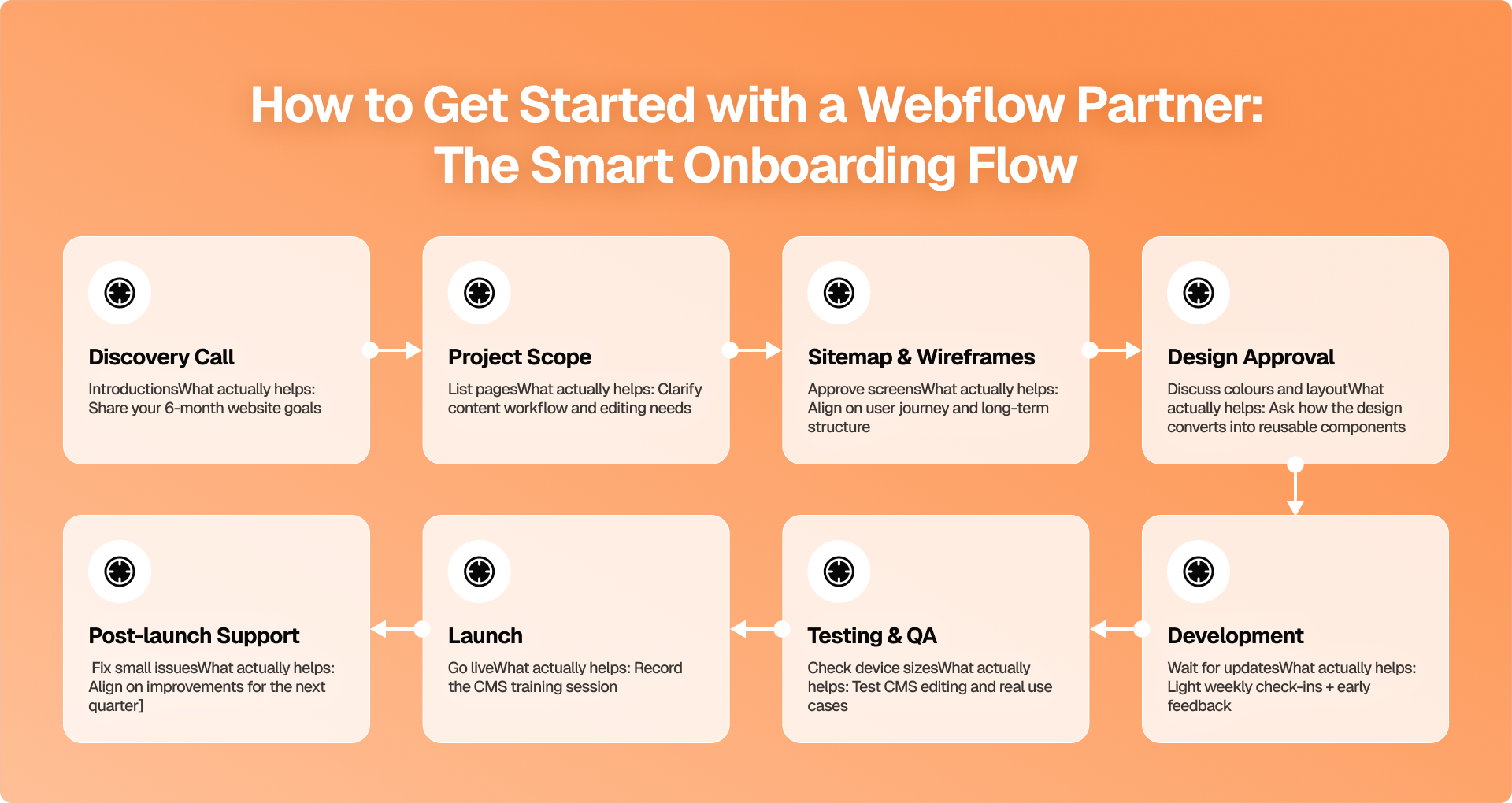
To get started with a Webflow Partner, the first thing to know is that most teams follow a familiar project flow. You’ll have a kickoff call, review a scope, look at a sitemap, approve design, and move into development.
Think of this stage like building the foundation of a house. You don’t see it later, but it decides how strong everything feels. Those steps don’t change much from partner to partner. What really shapes the success of your project is everything you do around those steps.
A smooth start begins with clarity. Before the first call, jot down what success looks like for your website over the next six months. It doesn’t need to be a long document. A simple note on goals, key pages, and who your website needs to serve helps the partner plan your build with more accuracy.
Mini exercise: Write your homepage goal in one sentence. If it feels vague, the partner has no chance of hitting it.
Another helpful step is gathering your brand and content essentials early. Even rough drafts of copy, product details, existing assets, and examples of what you like gives the partner a head start. It also prevents the common “we’re waiting on content” slowdown later. One shared folder with your essentials is usually enough.
When the partner starts discussing structure, pay attention to how they think about components and CMS planning. Ask Webflow partners how your website will scale if your team doubles its content next year. A short conversation like this reveals whether they’re planning for today or building for the long run.
During design, ask for clarity on how the layouts will translate into Webflow components. You don’t need technical details, just an understanding of what you’ll be able to edit easily after launch. If something looks complex, ask early. Partners appreciate feedback while things are still flexible.
As the build progresses, keep communication simple and steady. A weekly check-in or a quick annotated link is enough. Whenever you spot something unclear, mention it right away. Early clarity keeps the project smooth.
Before launch, expect a proper walkthrough. Your team should know how to update CMS items, create new pages, and manage simple content changes.
Simple test: Ask your partner to show you how to create a new CMS item. If it takes more than 30 seconds, the system is too complicated.
One tip that helps a lot is to record this session. It becomes your reference whenever new team members join.
If you want the best possible start, approach the first week like a shared setup phase. Communicate openly, prepare your essentials early, and ask the questions that matter to your long-term plans. A good Webflow partner does the heavy lifting, but the clarity you provide makes their work stronger and your website better.
Ashok’s shortcut: Name your folder “Website Essentials - v1.” Add rough text, brand files, and a few references. Done. Don't overthink it.
The Pixeto Check: “A good Webflow partner builds something you’re proud to show, and confident enough to edit yourself.”
Choose the Right Webflow Partner for Long-Term Growth
Choosing the right Webflow partner is about more than launching a good-looking site. The best Webflow professional partners help your team move faster, keep your site easy to manage, and build systems that scale as your business grows.
That’s exactly what the Webflow Partner Program is designed to recognize, teams that combine strong design, clean development, and long-term thinking.
Before making a decision, get clear on what success looks like for your website: speed, flexibility, conversions, or growth. Then use this guide to compare how each Webflow partner approaches structure, scalability, and ongoing workflows, not just visuals.
If you’re ready to move forward, shortlist two or three partners from this list and start conversations with the teams that align with your goals. The right Webflow partner won’t just build your site, they’ll help future-proof it.
If you’re comparing service providers, this list of top Webflow agencies offers a broader view of experienced teams.
FAQs
1. What is a Webflow Partner?
A Webflow Partner is an agency or freelancer officially recognised by Webflow for their experience and quality of work on the platform. They follow Webflow’s recommended standards and are listed through the Webflow Partner Program.
2. How do I choose the best Webflow Partner for my project?
Look for a partner whose experience matches your website goals. Review their past Webflow builds, check how they structure CMS systems, and see whether their questions show they understand your audience, workflow, and long-term plans.
3. Are Webflow Partners certified by Webflow?
Yes. Partners submit their work, share their approach, and are approved by Webflow based on experience and quality before being listed in the program.
4. How much does it cost to hire a Webflow Expert?
Costs vary widely. Smaller sites may not be as expensive, while complex SaaS or enterprise builds can go much higher. Pricing depends on scope, design complexity, animations, CMS needs, and level of support.
5. Do Webflow Partners provide custom coding and integrations?
Yes. Most partners offer custom code, API integrations, automation setups, and third-party tool connections when needed.
6. Can Webflow Partners migrate my site from WordPress/Wix?
Yes. Many partners specialise in migrations and can rebuild your site in Webflow with a cleaner CMS structure and improved design.
7. Are Webflow Partners good for SaaS companies?
Yes. Many SaaS brands use Webflow Partners for marketing sites, landing pages, resource hubs, and fast experiments. Partners understand how to build scalable, CMS-driven systems that support growth.
8. How long does it take to build a Webflow website?
Timelines vary by project, but most Webflow builds take anywhere from 3 to 10 weeks. Larger, more complex sites with custom CMS and design systems can take longer.
9. Do Webflow partners offer ongoing support and maintenance?
Most partners do. They help with updates, new pages, optimisation, and continuous improvements after launch.
10. Is it worth hiring a Webflow Partner over freelancers?
If you need structure, scalability, and long-term reliability, yes. Partners bring verified experience, stronger processes, and deeper platform knowledge than general freelancers.